
Patient and family education
Clear information and simple tools to look after your heart, prepare for your tests and take part in your care.
What do you need today?
Explore the topics
21 resources
Know your test
- Electrocardiogram (ECG)Records your heart's electrical activity in just a few minutes. It doesn't hurt and needs no special preparation.
- Transthoracic echocardiogramAn ultrasound of the heart that shows its size, how it moves and how its valves work. It does not use radiation.
- Stress test and stress echocardiogramShows how your heart responds when it works harder, either while you walk on a treadmill or with a medicine.
- Holter monitor for heart rhythmA small device records your heart rhythm nonstop while you go about your normal life.
- Ambulatory blood pressure monitoring (ABPM)A cuff measures your blood pressure automatically during the day and night while you go about your normal life.
- Myocardial perfusion scan (nuclear heart scan)A nuclear medicine test that shows how blood reaches your heart muscle, at rest and after stress.
- Preparing for your testFasting, medicines and what to bring, test by test.Page
Emergencies
Heart conditions
Prevention
- Know your heart numbersBlood pressure, pulse, weight and waist say a lot about your risk. Calculate your body mass index (BMI) and check your waist.Tool
- Hormesis: the right dose makes you strongerThe right dose of effort, with good rest, helps your body adapt. Learn the idea behind our HORMESIS program and explore it on an interactive curve.Tool
- HORMESIS prevention programProfessional support to look after your heart and change habits.Page
Healthy living
- Heart-healthy eatingSimple changes in what you eat and how you cook it help control your weight, cholesterol and blood pressure.
- Safe physical activityMoving makes your heart stronger. Learn how much, how to get started and which signs tell you to stop.
- Vitamin N: nature as part of your careSmall moments in contact with nature can help lower stress and look after your heart. Choose your doses and keep track of your week.Tool
- Biophilia: your heart calms down near living thingsBeing close to plants, water, animals and natural light can help lower stress. Learn why, and try a guided breathing exercise right now.Tool
Living with your treatment
- How to take your blood pressure at homeStep-by-step instructions to measure it correctly, and a log to write down your results and bring them to your appointment.Tool
- Deciding with your doctorWhen there is more than one option, such as a procedure, a medicine or watching and waiting, you can decide together with your doctor. Here is how to prepare for that conversation.
Patient safety
Rights and regulations
We could not find that topic. Try another word or write to us. Ask on WhatsApp
Tools you can use online
They work in your browser. Nothing you type is saved on our servers.
- Is it an emergency?In: Warning signs of a heart attack and a stroke
- Check your riskIn: High blood pressure (hypertension)
- Work out your BMI and waistIn: Know your heart numbers
- Explore the hormesis curveIn: Hormesis: the right dose makes you stronger
- Take this week's challengeIn: Vitamin N: nature as part of your care
- Breathe with the 4-4-6 guideIn: Biophilia: your heart calms down near living things
- Keep your blood pressure logIn: How to take your blood pressure at home
Heart words in plain language
Tap a word to see what it means.
Abdominal obesity
Too much fat around the belly. It is suspected when the waist measures more than 80 cm in women or more than 90 cm in men.
Arrhythmia
A problem with the heart's rhythm: it beats too fast, too slow or irregularly.
Beta blocker
A type of medicine that slows the heart rate and lowers blood pressure, such as metoprolol or carvedilol.
Blood pressure monitor
A device that measures blood pressure.
Body mass index
A ratio of weight to height that helps show whether a weight is healthy.
Cardiac catheterization
A procedure in which a thin tube (catheter) is passed through an artery to the heart to look at or treat its arteries.
Cholesterol
A fat in the blood. When there is too much, it builds up in the walls of the arteries.
Diastolic pressure
The lowest pressure, when the heart rests between beats. It is the bottom number.
Ejection fraction
The percentage of blood the heart pumps out with each beat. It shows how strongly it pumps.
Electrode
A small sticker placed on the skin to pick up the heart's electrical signals.
Gamma camera
Nuclear medicine equipment that takes images of the body using the radiopharmaceutical.
Heart attack
Damage to the heart muscle because one of its arteries gets blocked and blood stops reaching it.
Holter monitor
A small device you wear for hours that records your heart rhythm or blood pressure while you go about your day.
Hypertension
Blood pressure that stays high over time.
Informed consent
Written permission you give after a procedure, its benefits and its risks have been explained to you.
Insulin resistance
When the body responds less to insulin, the hormone that helps sugar move from the blood into the cells. It can appear before diabetes.
Legumes
Beans, lentils, chickpeas, peas and fava beans. They provide protein and fiber.
Metabolic flexibility
The body's ability to switch fuels: using mostly sugar after a meal and more fat between meals or during gentle, longer activity.
Metabolism
All the processes the body uses to turn food into energy and to use or store it.
Murmur
A sound heard as blood flows through the heart. Sometimes it means a valve is not working well.
Nuclear medicine
A specialty that uses small doses of radiopharmaceuticals to take pictures of how organs work.
Palpitations
Feeling that your heart is pounding, racing or beating irregularly.
Perfusion
Blood flow reaching an organ. In the heart, it shows whether blood reaches all of the muscle.
Radiopharmaceutical
A medicine with a small amount of a radioactive substance that makes nuclear medicine images possible.
Stroke
Damage to the brain because a blood vessel gets blocked or bursts.
Systolic pressure
The highest pressure, when the heart squeezes. It is the top number.
Transducer
A device moved over the skin to take ultrasound images.
Triglycerides
A type of fat in the blood. They can rise with too much sugar, refined flour, alcohol and calories; genes, diabetes and some medicines also play a part.
Ultrasound
Sound waves you cannot hear that show the inside of the body, as in a sonogram. They have no radiation.
Valve
A door inside the heart that lets blood flow in only one direction.
Our education program
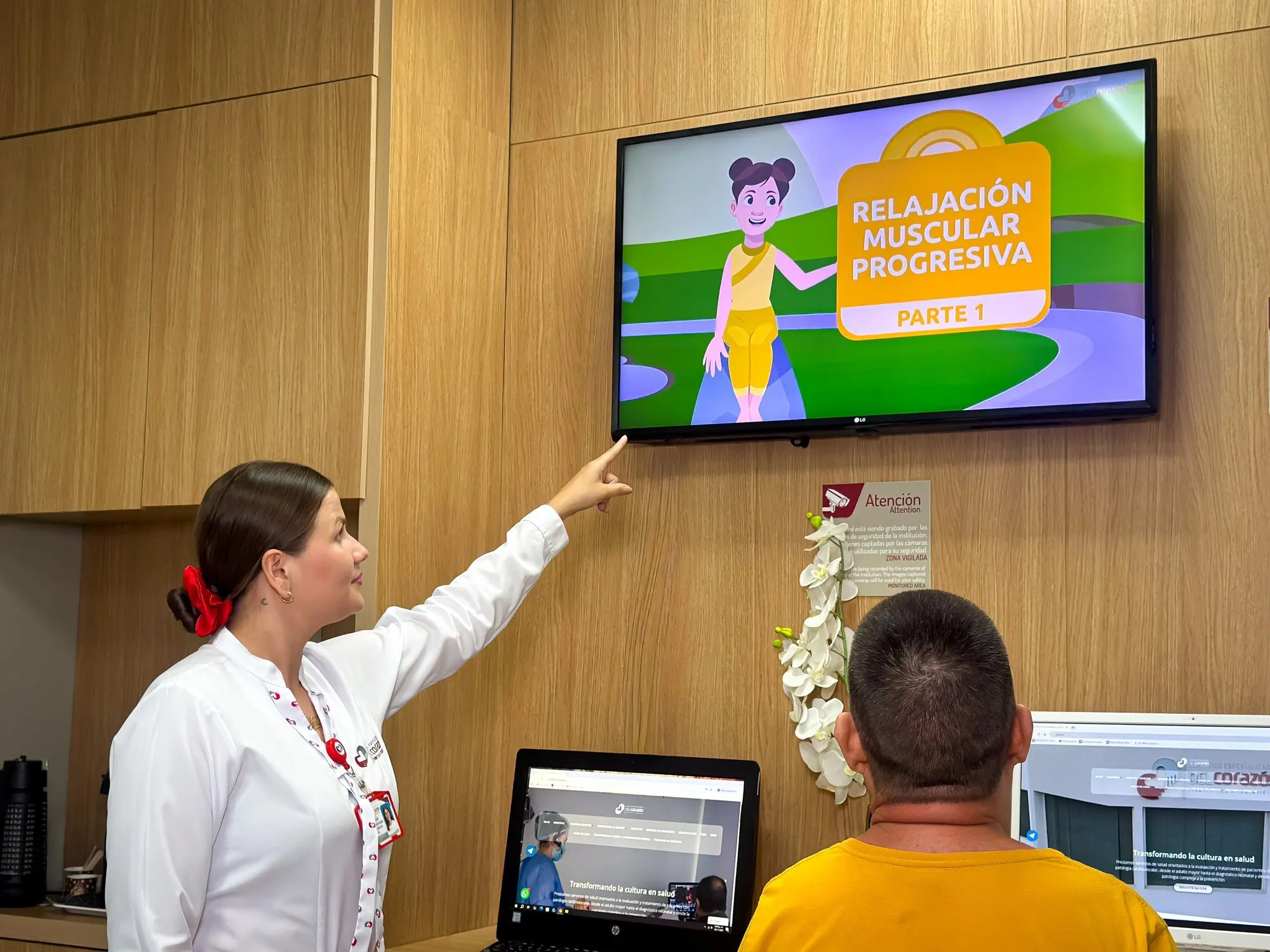
Through our Patient and Family Education Program, our patient services staff and clinical team share topics on patient safety, healthy living and prevention with patients and companions every day, and explain their rights and responsibilities. We do this in all our services.
- Talks in our waiting rooms
- Educational videos on the screens at our locations
- Heart Week, with cardiovascular risk screening
- Dance therapy, music therapy and relaxation techniques
All our clinical and administrative staff are committed to your education: we assess what you need to learn and keep the topics that matter most for your health and quality of life up to date.
Patient and family education policy, version 03, September 2026
Need an appointment?
Book online or message us on WhatsApp. We reply during opening hours.